

Sometimes things change
sometimes they don't

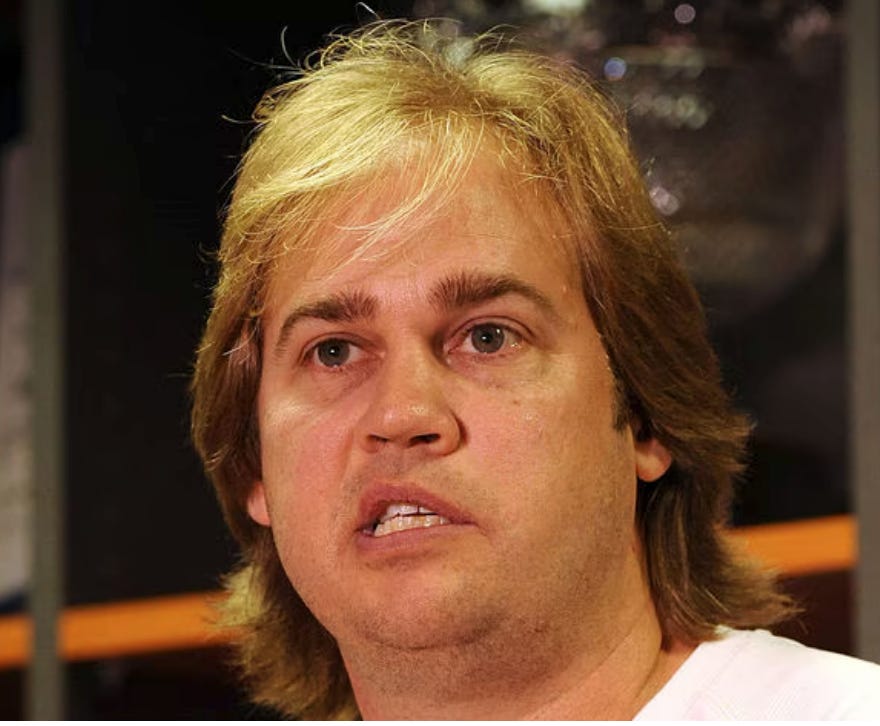
Eddy Groves. Former CEO of ABC Learning – the corporate that went bust, putting at risk education and care for over 120,000 children in more than 1,000 centres, and costing the Australian taxpayer around $120 million in direct Commonwealth intervention to stabilise the sector. Yeah, that one.
You’d think he’d be the number-one person never to invite to speak at a conference in this sector. I mean, what on earth could anyone here possibly learn from the man who helped build the entire model of real-estate moguls getting rich at the expense of children – and who was a bad businessman to boot? But here he was, advertised as the key drawing card at a sector conference.
I’m not going to name and shame the conference, because an interesting thing happened on the way to it. It’s called the power of advocacy. A few of us who thought having Eddy speak was… not the best optics… quietly alerted other speakers on the program. They contacted the organiser and, faster than the speed of light, the entire conference was suddenly cancelled.
So alas, we will never get to hear Eddy’s pearls of wisdom.
In Plain Sight
In Plain Sight, the report documenting the many shocking failures of systems to stop one of Australia’s worst paedophiles before he harmed more and more children, was released this week. To give you a sense of the scale of those failures: the first child to disclose abuse – describing explicit sexual harm during nappy changes – told a parent in 2009. He was not arrested until 2022. That 2009 case was reported to police. He was reported two more times. He was sacked from five centres. He was reported to the regulatory authority…
Read the report. It is heartbreaking.
But I want to quote a paragraph by Luke Twyford, Chairperson of the Child Death Review Board, who led the Inquiry. It is stunning in its clarity:
“Similarly, I have had to consider the world of federal government and the world of local communities. One operates at scale, shaping policy and legislation from afar, the other lives the impact of these decisions in daily realities. Local communities are where the safety of children is determined. It is the neighbour, the friend, the childcare worker [sic] who notices, acts, and protects. Federal parliament and the debates about safeguarding are not unimportant, but the distance between these two worlds can create a gap in understanding that leads to policies and laws that communities must carry. Without careful attention, the voices of those closest to children can be drowned out by the machinery of governance.”
Beginning of the end for private equity and corporate provision?
This week the NSW Government ordered Affinity Early Learning to stop opening new services until 95% of its existing services are meeting the National Quality Standard – and crucially, it can’t reach that figure simply by selling off or closing the ones that aren’t. It must train its staff in child protection, implement higher ratios at Working Towards services (including a 1:3 ratio for babies!), and install CCTV at all services.
Why is this so important? Because apart from being a very direct message to Affinity to get their act together, it’s a much bigger message to every private equity fund eyeing off education and care: this is not an easy investment. Governments will intervene in their money-making schemes, and those interventions will cost real money. It signals to every PE fund that this is a no-go sector unless they are prepared to actually invest in quality. And it signals to Quadrant – Affinity’s owners – that it’s time to start planning a very quick exit strategy, given the government has now dashed any hope of selling the company to another private equity buyer.
The NSW Government has backed its words with action: it has closed a centre on the Central Coast – in an area already facing a dire shortage of places – until mould and rodent issues were fixed.
And corporates?
When ABC Learning’s share price collapsed by 43% back in 2008, it was the market’s way of yelling that something was very, very wrong – and it turned out to be right. G8 Education’s share price has now fallen by around 45%. I’m not saying history is repeating, but the rhyme is getting uncomfortably loud.
A plunging share price doesn’t, on its own, mean a company is about to topple – but it does expose just how jittery investors are about the whole corporate childcare experiment, and that should set off alarm bells in every government office with a stake in this system.
What ideas are lying around?
Last year, when giving evidence to the Productivity Commission, I was begin with this statement. ‘I was surprised to read a Milton Freedman quote in a book written by esteemed professor of early education, Peter Moss. But it’s a quote worthy of inclusion and repeating here. He said:
“Only a crisis, actual or perceived, produces real change. When that crisis occurs, the actions that are taken depend on the ideas that are laying around. That, I believe, is our basic function: to develop alternatives to existing policies, to keep them alive and available until the politically impossible becomes the politically inevitable.”
The crisis I was predicting in our sector did, of course, arrive this year – perhaps too soon for some of the Productivity Commission’s proposed ideas to be ready to pick up and run with.
What worries me is that we still don’t have a clear, united ask in the sector. I’m hearing a shopping list of ideas from educators and the sector, but none have gathered enough momentum to become the idea everyone can rally behind.
So what should that one big idea be? If we could only ask governments for a single change to keep children safer in education and care settings, what would you choose?
Getting rid of for profit centres would be my first start - I agree with the above comments of higher ratios, however that is no good if the educators aren't trained properly. Making sure the training college's are reputable.
I would choose ratio changes and room sizes 1:3 for babies (max 12), I think 1:5 is ok for 2 year olds But 1:4 would be better, and 1:7 for 3-5s (21) or better yet (15- yes I know 7 plus 7 doesn't equal 15, but it would require three educators in that room) AND trainees should NOT be counted in ratios, but I would love to see them as an extra educator in a lot of classrooms, especially in places with high needs according to AECD data. These would be my minimum legislative changes. The flow on from these changes would be huge! Educators can actually BE with the children which children need and there is a lot of research which shows educator well-being is higher because one of the most important thing for job satisfaction for educators is to actually be with the children- and our Trainees can be mentored properly. It would increase attrition rates, so greater stability for children, and teams can stay together longer which builds more skilled teams.